

While working on a synchronization Sync (synchronization) sends changes from your device to Mohojo Werks’ servers and brings those changes to your other devices when they sync. This keeps your Accumoo data up to date across devices. fix for Accumoo, I realized I had another problem: I had no way to require users running an affected app version to upgrade.
I could fix the bug, submit an update to Apple, and make it available on the App Store. But users would still need to install it. Until they did, they could keep using the version with the bug.
Accumoo had no built-in way to tell these users that an update was required before they could continue using the app. I was shortsighted; I knew I had to deliver a fix. But, I had no way to require the upgrade.
This is how an update screen became something I wish I’d shipped on day one.
The fix has to reach the installed app
Accumoo saves progress locally and synchronizes with our Rails backend. I cover this separation in the local-first article and the synchronization article.
The synchronization fix needed changes to both the backend and the app. A server deployment could help the installed apps, but it couldn’t add missing retry logic to a binary sitting on a phone.
Requiring an update lets me direct users to the App Store when their installed version needs replacing. I still need to decide when that interruption is justified and make sure they can complete the update.
There’s a lot of work between “the fix” available on the App Store, and “the fix” installed on the client.
What I’ve added
Accumoo 1.9.8 is released, with a minimum-version check behind a feature flipper flag. The check still needs testing before I rely on it to require updates. It reads the installed app version and build, identifies an eligible App Store installation, and asks the backend whether an update is required.
When an applicable update is required, Accumoo presents an Update Accumoo dialog, with Open App Store and Check again buttons. The backend controls the requirement, which means I can change or withdraw it as circumstances change.
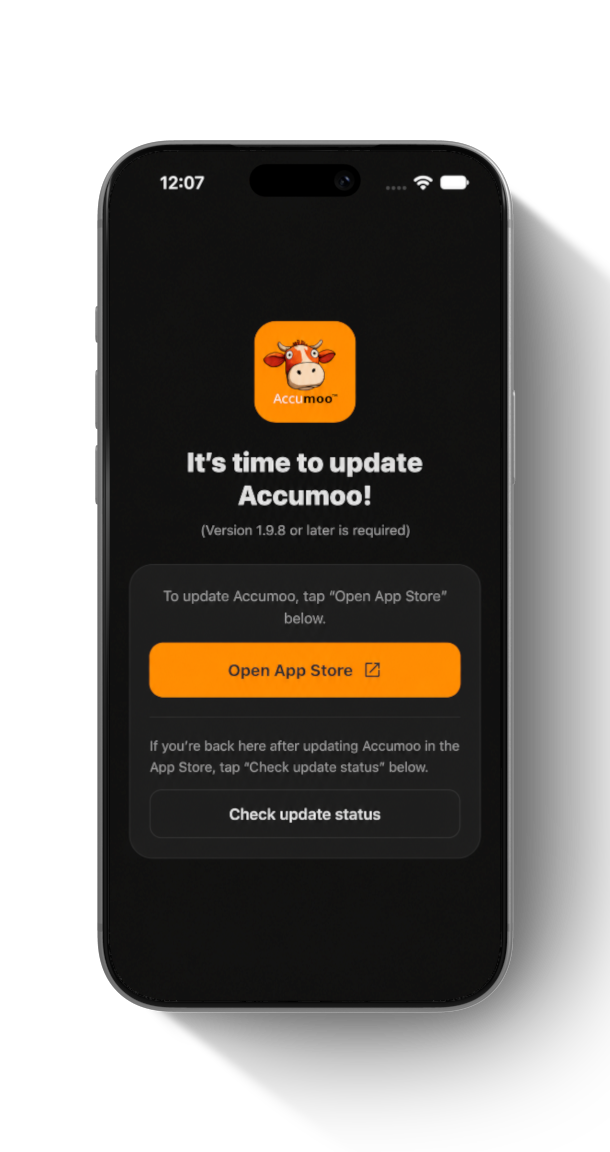
Illustrative mockup; the version number was edited for this example.
View the full-size illustration
Requiring an update shouldn’t put someone’s saved progress or unfinished work at risk. I still need to test that behavior before enabling the requirement.
But, there’s an important catch: a version that shipped without this check won’t know to ask for it. Adding the capability now, prepares future versions for a future update requirement. Unfortunately, we can’t retroactively give older, installed Accumoo versions this behavior.
That’s the part I wish I’d thought through earlier. I needed to ship the recovery mechanism before I needed to rely on it.
Where this stands
Accumoo 1.9.8 is released, but the minimum-version check still needs testing. It remains behind a feature flipper flag.
I still need to verify the distribution checks, an in-place upgrade with pending data, and the experience on the phone, including VoiceOver. Any replacement version I require must also be publicly available to the users being asked to install it.
The sync incident made me think beyond writing the fix. It made me think about how I could help users reach it when an older app version needs upgrading.
I wish I’d included this capability from day one. It’s in place now; I still need to test it before relying on it the next time I need it.